




Summary
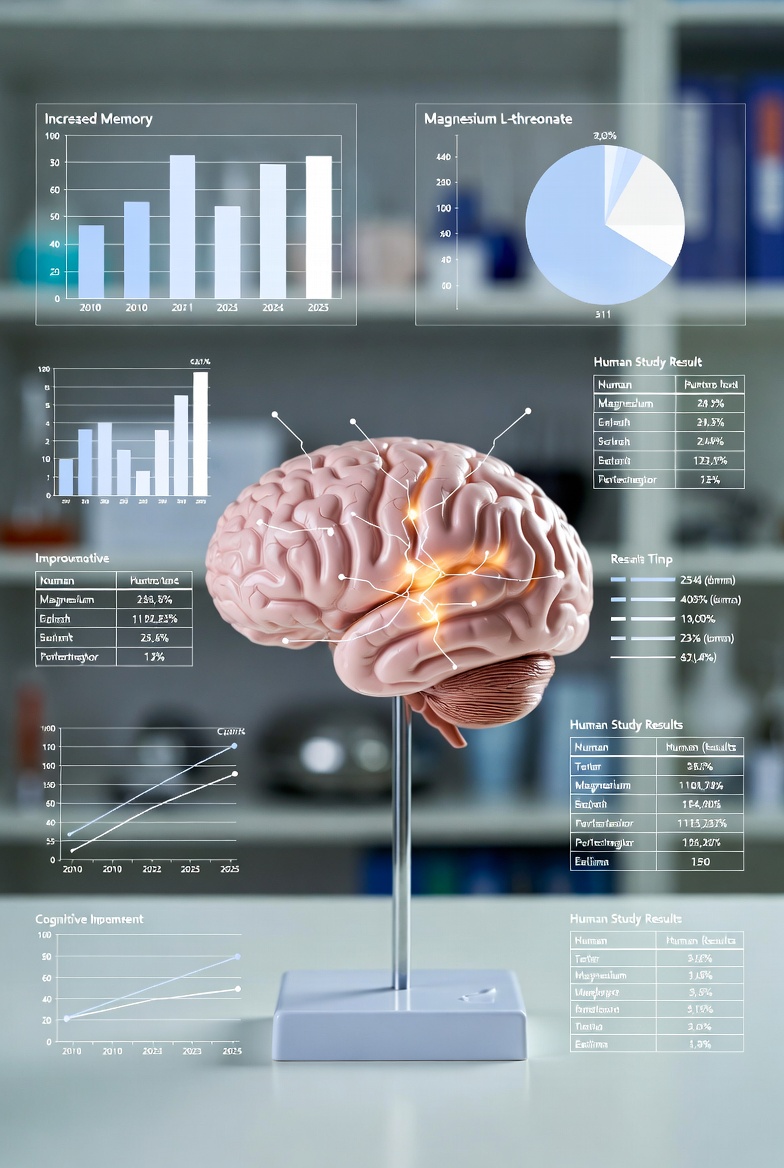
Magnesium L-threonate, often marketed as Magtein, has emerged as a frontrunner in nutritional neuroscience for its potential to combat age-related cognitive decline. Developed by researchers at MIT, this unique form of magnesium is designed to cross the blood-brain barrier more effectively than traditional supplements, leading to elevated brain magnesium levels that support synaptic plasticity and memory function. Preclinical studies in animals have demonstrated its ability to reverse markers of brain aging, such as synaptic loss and cognitive deficits, while human trials show improvements in memory, executive function, and even a perceived reversal of “brain age” by up to 14 years. However, while it stands out for its brain-specific bioavailability, evidence does not conclusively prove it as the only form capable of such effects—other magnesium variants offer cognitive benefits through different mechanisms. This report delves into the scientific studies, mechanisms, limitations, and future implications, drawing from peer-reviewed research and clinical trials.
Background on Magnesium and Brain Health
Magnesium is an essential mineral involved in over 300 enzymatic reactions in the body, including those critical for neuronal signaling and synaptic function. As we age, brain magnesium levels naturally decline, contributing to reduced synaptic density, impaired plasticity, and cognitive deterioration—hallmarks of brain aging. Traditional magnesium supplements (e.g., oxide, citrate, glycinate) primarily address systemic deficiencies but struggle to penetrate the blood-brain barrier, limiting their impact on cerebral magnesium levels.
Enter magnesium L-threonate (MgT), a compound pairing magnesium with L-threonic acid, a metabolite of vitamin C. Pioneered in a 2010 study published in Neuron, MgT was shown to uniquely elevate magnesium in the cerebrospinal fluid and hippocampus of rats, enhancing NMDA receptor activity, long-term potentiation (LTP), and synaptic strength. This foundational research suggested MgT could not only prevent but reverse age-related synaptic loss, effectively rejuvenating cognitive performance in older animals.
Key Preclinical Studies: Evidence from Animal Models
Animal research provides the strongest evidence for MgT’s brain-reversing potential. In the seminal 2010 MIT-led study, aged rats supplemented with MgT exhibited restored synaptic density in the hippocampus to levels comparable to young rats, alongside improved spatial and associative memory. The study compared MgT to other forms like magnesium chloride and gluconate, finding that only MgT significantly increased brain magnesium and reversed cognitive deficits.
Subsequent studies reinforced these findings:
- A 2024 investigation in aged mice showed MgT supplementation improved learning in water maze tests by modulating synaptic configurations, supporting cognitive function during aging.
- In Alzheimer’s disease (AD) models, MgT alleviated symptoms by influencing the microbiota-gut-brain axis, reducing amyloid-beta plaques, and enhancing memory in transgenic mice. These effects were linked to increased brain-derived neurotrophic factor (BDNF) and reduced neuroinflammation.
These preclinical results highlight MgT’s uniqueness: its ability to target brain-specific magnesium deficits, leading to structural and functional reversal of aging markers. No other magnesium form has demonstrated comparable brain penetration in direct comparisons.
Human Clinical Trials: Translating Animal Findings
Human evidence, while promising, is more limited and mixed, with most studies focusing on MgT rather than head-to-head comparisons with other forms.
- A 2016 randomized controlled trial (RCT) involving 44 older adults with mild cognitive impairment tested 1.5–2 g/day of MgT for 12 weeks. Participants showed significant improvements in executive function, working memory, and episodic memory, with composite scores indicating a reversal of brain aging by approximately 9 years based on standardized tests like the Trail Making Test.
- In a 2022 double-blind RCT with 98 healthy Chinese adults, a MgT-based formula (2 g/day for 30 days) enhanced memory performance across multiple domains, with pronounced benefits in older subgroups.
- A 2025 RCT in 100 adults reported that 6 weeks of MgT supplementation improved overall cognition, working memory, reaction time, and “cognitive age,” alongside better sleep quality.
- Another 2024 study linked MgT to improved objective and subjective sleep metrics, which indirectly support cognitive health by reducing fatigue and enhancing mental alertness.
Ongoing trials, such as NCT02210286, are examining MgT’s effects on dementia patients, aiming to assess enhancements in learning and memory. Reviews from organizations like the Alzheimer’s Drug Discovery Foundation note pilot RCTs showing cognitive benefits in those with subjective memory complaints.
However, not all studies are unanimous. Some human trials report modest or null effects, possibly due to variations in dosage, duration, or participant health status.
Is MgT the Only Form That Reverses Brain Aging?
While MgT is validated for its superior brain bioavailability, claims of it being the “only” form are overstated. A 2024 systematic review and meta-analysis of magnesium and cognitive health analyzed various forms, finding:
- Dietary magnesium intake (around 240 mg/day) and optimal serum levels (0.85 mmol/L) are associated with reduced dementia risk and better cognition.
- Other supplements like magnesium glycinate and oxide show benefits in memory and dementia prevention, though often through systemic anti-inflammatory or vascular effects rather than direct brain magnesium elevation.
- U-shaped associations suggest both deficiency and excess can harm cognition, emphasizing balance over form.
Direct comparisons are scarce, but animal data clearly favors MgT for brain-specific reversal. In humans, MgT’s effects on synaptic restoration appear unique, but broader magnesium supplementation may suffice for general cognitive protection.
Limitations and Future Directions
Key limitations include small sample sizes in many RCTs, potential publication bias toward positive results, and a lack of long-term studies beyond 12 weeks. Individual factors like baseline magnesium status, age, and comorbidities influence outcomes. Safety is generally high, with mild gastrointestinal side effects reported at high doses.
Future research should prioritize large-scale, head-to-head trials comparing MgT to other forms, longitudinal studies on healthy aging populations, and mechanistic insights via neuroimaging. As of 2026, with an aging global population, MgT holds exciting potential but requires more robust validation.
Recommendations
For individuals in Providence, Rhode Island, or similar demographics (e.g., adults over 50), consulting a healthcare provider before starting MgT (typical dose: 1-2 g/day) is advised. Combine with a magnesium-rich diet (nuts, greens, whole grains) for synergistic effects.
In conclusion, magnesium L-threonate offers compelling evidence for reversing aspects of brain aging, but it’s not unequivocally the sole solution—it’s a powerful tool in a broader cognitive health arsenal.
References
- Frontiers in Nutrition: The effects of magnesium L-threonate (Magtein®) on cognitive performance and sleep quality in adults (2025) – https://www.frontiersin.org/journals/nutrition/articles/10.3389/fnut.2025.1729164/full
- PubMed Central: A Magtein®, Magnesium L-Threonate, -Based Formula Improves Brain Cognitive Functions in Healthy Chinese Adults (2022) – https://pmc.ncbi.nlm.nih.gov/articles/PMC9786204
- Life Extension: Magnesium L-Threonate: Brain Benefits – https://www.lifeextension.com/magazine/2018/6/reverse-clinical-measures-of-brain-aging
- ScienceDirect: Magnesium and Cognitive Health in Adults: A Systematic Review and Meta-Analysis (2024) – https://www.sciencedirect.com/science/article/pii/S2161831324001066
- Green Mountain Physical Therapy: Unique Magnesium Found to Reverse Brain Aging (2025) – https://www.greenmtnpt.com/post/magnesium
- Neural Regeneration Research: Magnesium-L-threonate treats Alzheimer’s disease by modulating the microbiota-gut-brain axis (2024) – https://journals.lww.com/nrronline/fulltext/2024/10000/magnesium_l_threonate_treats_alzheimer_s_disease.29.aspx
- ClinicalTrials.gov: Magnesium L-Threonate for the Enhancement of Learning and Memory in People With Dementia (NCT02210286) – https://www.clinicaltrials.gov/study/NCT02210286
- Alzheimer’s Drug Discovery Foundation: Magnesium – https://www.alzdiscovery.org/uploads/cognitive_vitality_media/Magnesium-Cognitive-Vitality-For-Researchers.pdf
- Magceutics: The Science Behind Magnesium L-Threonate and Brain Health (2024) – https://magceutics.com/blogs/science/the-science-behind-magnesium-l-threonate-and-brain-health
- Nutraceutical Business Review: Supporting healthy brain ageing with a unique magnesium compound (2025) – https://nutraceuticalbusinessreview.com/supporting-healthy-brain-ageing-with-a-unique-magnesium
- AJMC: Study: Magnesium-L-Threonate Improves Objective, Subjective Sleep Quality (2024) – https://www.ajmc.com/view/study-magnesium-l-threonate-improves-objective-subjective-sleep-quality
- Martin’s Wellness: Magnesium for Brain Health Regeneration – https://martinswellness.com/blog/post/regeneration-of-brain-structures
- MIT News: Magnesium may reverse middle-age memory loss (2004) – https://news.mit.edu/2004/magnesium
- Nutritional Outlook: Study finds that magnesium L-threonate may impact synaptic configuration to support cognitive function during aging (2024) – https://www.nutritionaloutlook.com/view/study-finds-that-magnesium-l-threonate-may-impact-synaptic-configuration-to-support-cognitive-function-during-aging
- Momentous: 5 Science-Backed Benefits of Magtein Magnesium (2026) – https://www.livemomentous.com/blogs/all/magtein-benefits
- MWHP: Cognitive Benefits of Magnesium Threonate (2022) – https://www.mwhp.com/cognitive-benefits-of-magnesium-threonate

REPORT | “Pollution Isn’t Patriotic”
“Pollution Isn’t Patriotic”: American Rivers Mobilizes for Clean Water as a National Priority In January 2025, the conservation organization American…




Leave a Reply