

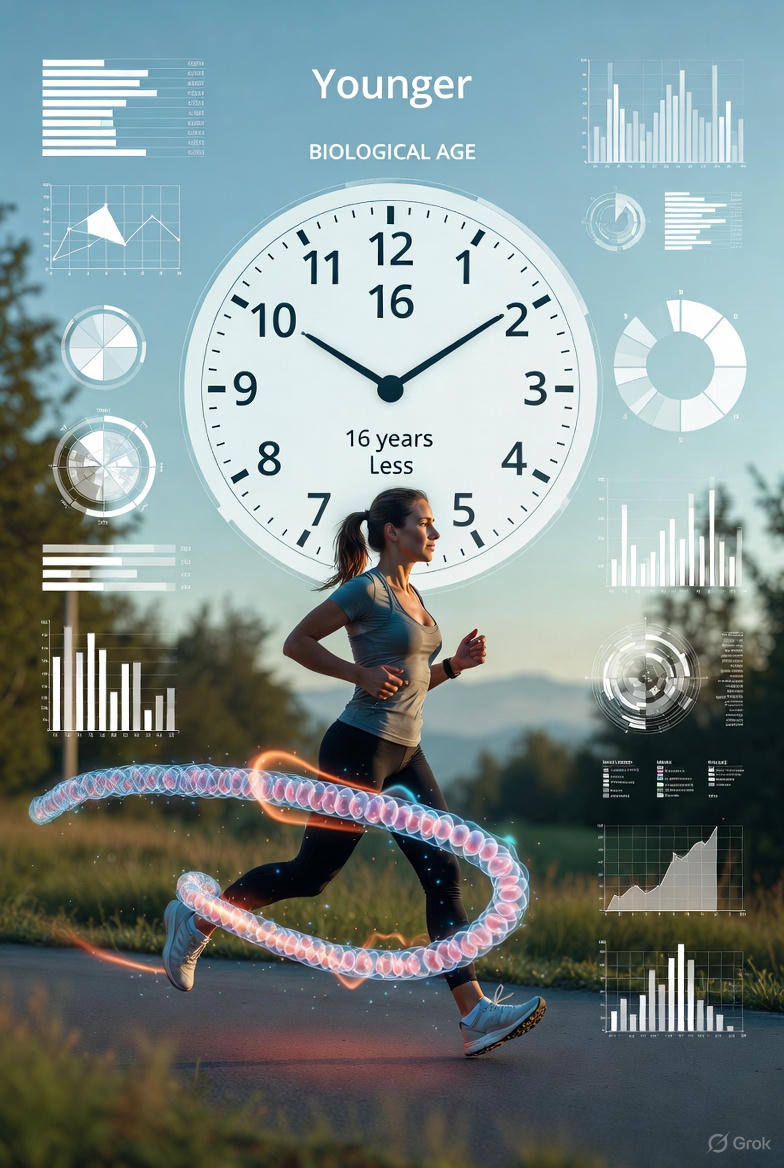



As the quest for longevity intensifies in an aging global population, simple lifestyle interventions like walking are gaining scientific spotlight. A groundbreaking 2022 study, still reverberating through 2025 publications, suggests that maintaining a brisk walking pace of over 4 miles per hour (mph) could equate to a biological age up to 16 years younger than one’s chronological age by midlife. This report delves into the core research, supporting evidence, mechanisms, limitations, and implications, drawing on recent analyses and confirmations. While no entirely new large-scale studies emerged in 2025-2026 replicating the exact metric, the findings continue to influence health recommendations, emphasizing pace over mere steps for anti-aging benefits.
The Landmark 2022 Study: Establishing the 16-Year Youth Boost
The pivotal research stems from a 2022 analysis of 405,981 middle-aged UK Biobank participants, published in Communications Biology. Researchers, led by the University of Leicester team, examined self-reported walking paces: slow (<3 mph), steady/average (3-4 mph), or brisk (>4 mph). They measured leukocyte telomere length (LTL), a key biomarker of biological aging that shortens with cellular division and is linked to age-related diseases like cardiovascular issues and dementia.
Key findings:
- Brisk walkers had significantly longer telomeres compared to slow walkers, independent of total physical activity volume, body mass index (BMI), smoking, or socioeconomic factors.
- The LTL difference translated to an estimated 16 years of reduced biological aging by midlife (e.g., a 50-year-old brisk walker might have the telomere profile of a 34-year-old slow walker).
- Using Mendelian randomization—a genetic method to infer causality—the study confirmed that faster walking pace directly contributes to slower aging, rather than just correlating with healthier lifestyles.
This was the first study to causally link walking intensity to telomere length, building on earlier evidence that brisk walking could extend life expectancy by up to 20 years. The emphasis on pace (>4 mph) over duration challenged step-count obsessions, suggesting that “how fast” matters more than “how far” for cellular youthfulness.
Mechanisms: Why Pace Powers Anti-Aging
Telomeres act as protective caps on chromosomes, eroding with each cell division and accelerating under stress, inflammation, or poor lifestyle. Brisk walking appears to preserve them by:
- Enhancing cardiovascular fitness and reducing oxidative stress, which damages DNA.
- Boosting anti-inflammatory responses and mitochondrial function, key to cellular energy and longevity.
- Promoting better metabolic health, indirectly supporting telomere maintenance enzymes like telomerase.
The 2022 study’s causal inference via genetics ruled out reverse causation (e.g., healthier people walking faster), indicating brisk pace actively slows aging. Supporting this, a 2024 Mendelian randomization study in Aging journal analyzed walking pace’s impact on epigenetic clocks (GrimAge, PhenoAge, etc.), finding brisk walking delayed aging acceleration by 1-2 years per clock, though not quantifying the full 16-year effect. This reinforces that intensity triggers molecular pathways for youth preservation, beyond moderate activity.
Recent Confirmations and Related Research (2024-2026)
While no direct replications of the 16-year metric appeared in 2025-2026, the 2022 study has been widely cited and extended:
- A 2025 analysis recapped the findings, noting brisk walking (>4 mph) links to longer telomeres and a 16-year biological youth advantage, emphasizing intensity’s superiority over duration.
- Social media discussions in late 2025, including Threads and Instagram posts, popularized the claim, highlighting consistent 4 mph walking for a 16-year age reduction compared to <3 mph.
- A 2025 BBC overview tied slow walking to faster physical and cognitive aging, referencing related 2019 gait studies and aligning with the 2022 telomere results.
- Complementary 2025 research in the American Journal of Preventive Medicine (79,856 participants) showed fast walking (≥15 min/day) cut mortality by 20%, more effectively than prolonged slow walking. Another in the Journal of the American Geriatrics Society linked pace increases to functional improvements in older adults, implying delayed aging.
These updates affirm the original study’s relevance, with no contradictory evidence emerging by early 2026.
Limitations and Considerations
Despite the promise, caveats apply:
- Self-reported pace in the 2022 study may introduce bias, though subsets validated with accelerometers.
- The 16-year estimate is an approximation based on LTL differences, not a literal reversal; biological age markers like telomeres are proxies, not definitive.
- Results are observational at core, with causality inferred genetically—real-world trials are needed.
- Individual variability (e.g., starting fitness, genetics) means not everyone achieves the full benefit; slower walkers might still gain from gradual increases.
- Recent epigenetic studies (2024-2025) show weaker effects for walking duration/frequency, underscoring pace’s unique role but calling for more diverse populations beyond UK cohorts.
Future Implications: From Research to Routine
With global aging accelerating, brisk walking offers an accessible, low-cost anti-aging tool. If confirmed in trials, guidelines might shift to recommend 4+ mph paces for 30 minutes daily, potentially adding years to healthspan. Ongoing research could integrate wearables for precise pace tracking, or combine with diet for amplified effects. As of January 2026, this body of evidence inspires optimism: a simple stride upgrade might just turn back time at the cellular level. For personalized application, consult healthcare providers to build sustainable habits.

REPORT | Lift to Keep the Loss?
Lift to Keep the Loss: How Resistance Training Preserves Muscle During Calorie Restriction Study design and methods Main…




Leave a Reply