


Trash is the New Trend
In the spring of 2026, fashion weeks in Milan, Paris, and beyond delivered a collective middle finger to the era of quiet luxury, algorithmic perfection, and spotless “clean girl” aesthetics. The new rallying cry? Trash. Not as insult, but as deliberate style statement — both literal and metaphorical. Designers are staining shirts on purpose, scattering debris on runways, turning plastic caps and newspaper into couture, and building entire brands around irony, decay, and political satire. What was once hidden in the landfill or dismissed as “messy” is now walking the catwalk with unapologetic swagger.This isn’t a micro-trend. It’s a full-blown cultural recoil. After years of polished minimalism that felt increasingly tone-deaf amid economic uncertainty, climate crisis, and digital surveillance, fashion is choosing authenticity over aspiration. Imperfection is the new luxury. Waste is the new raw material. And “trashy” is suddenly très chic.
The Dirty Destroyed Aesthetic: Prada Leads the Rebellion
No collection captured the mood better than Prada’s Fall 2026 menswear show in Milan. Miuccia Prada and Raf Simons sent out crisp dress shirts deliberately splattered with artful stains — cuffs and collars marked by splotches that looked like coffee spills, ink, or the residue of real life. These weren’t accidents. They were the point.The show notes spelled it out: “Built on traces of tradition, pieces are composed with familiar elements transformed through a questioning of convention.” Pairing the stained shirts with razor-sharp tailoring and smart coats created deliberate friction — the polished and the imperfect colliding on the same body. The message was clear: in 2026, flawless feels fake. Lived-in feels honest.This “dirty destroyed” look isn’t isolated. It echoes across runways: frayed edges, intentional rips, paint drips, and deconstructed hems that scream “I’ve been worn, I’ve survived.” It’s the spiritual successor to earlier experiments — Balenciaga’s trash-bag leather purses in 2022, Chanel’s graffitied totes under Karl Lagerfeld, or Gucci’s dusty sneakers. But in 2026 it feels urgent, almost political. In a world of filtered Instagram feeds and AI-generated perfection, clothes that look like they’ve survived chaos become a quiet act of
Trashy Clothing: Anti-Luxury Luxury with Teeth
While Prada played with stains, Palestinian label Trashy Clothing took the concept further — straight into satire and resistance. Founded in 2017 by Shukri Lawrence and Omar Braika, the brand finally made its physical Paris Fashion Week debut with the Fall/Winter 2026 collection “In Divine Trust,” staged at the Institut du Monde Arabe.The show was raw, sexy, and unapologetically political. Thirty-three looks blended military khaki and olive tones with streetwear irony: printed skinny “jeans,” slogan polos, bootleg graphics, padded gilets, cargo pockets, balaclava hoods, and fez-inspired hats. Silhouettes oscillated between exposure (tiny tops, bare torsos) and armored protection (oversized collars, heavy boots). Sword-shaped jewelry from collaborator Mia Khalifa’s Sheytan World line appeared as both ornament and shield — literal blades turned fashion armor.The brand’s ethos is “anti-luxury luxury.” Lawrence describes their work as a mirror: “Everything we do with the brand is a reflection… we use satire to showcase that.” Drawing from the 2002 film Divine Intervention by Elia Suleiman, the collection processed the mechanics of occupation — checkpoints, surveillance, everyday control — through fashion that refuses to look polished or neutral. Low-fi styling, trash-culture references, and deliberate contradictions make “Trashy” not an insult but a badge of honor.Mia Khalifa opened and closed the show. Palestinian model Alana Hadid walked. The front row buzzed with energy. In a season where many brands played it safe, Trashy Clothing proved fashion can still be dangerous — glamorous and pointed at the same time.
Literal Trash Becomes Haute: The Upcycling Explosion
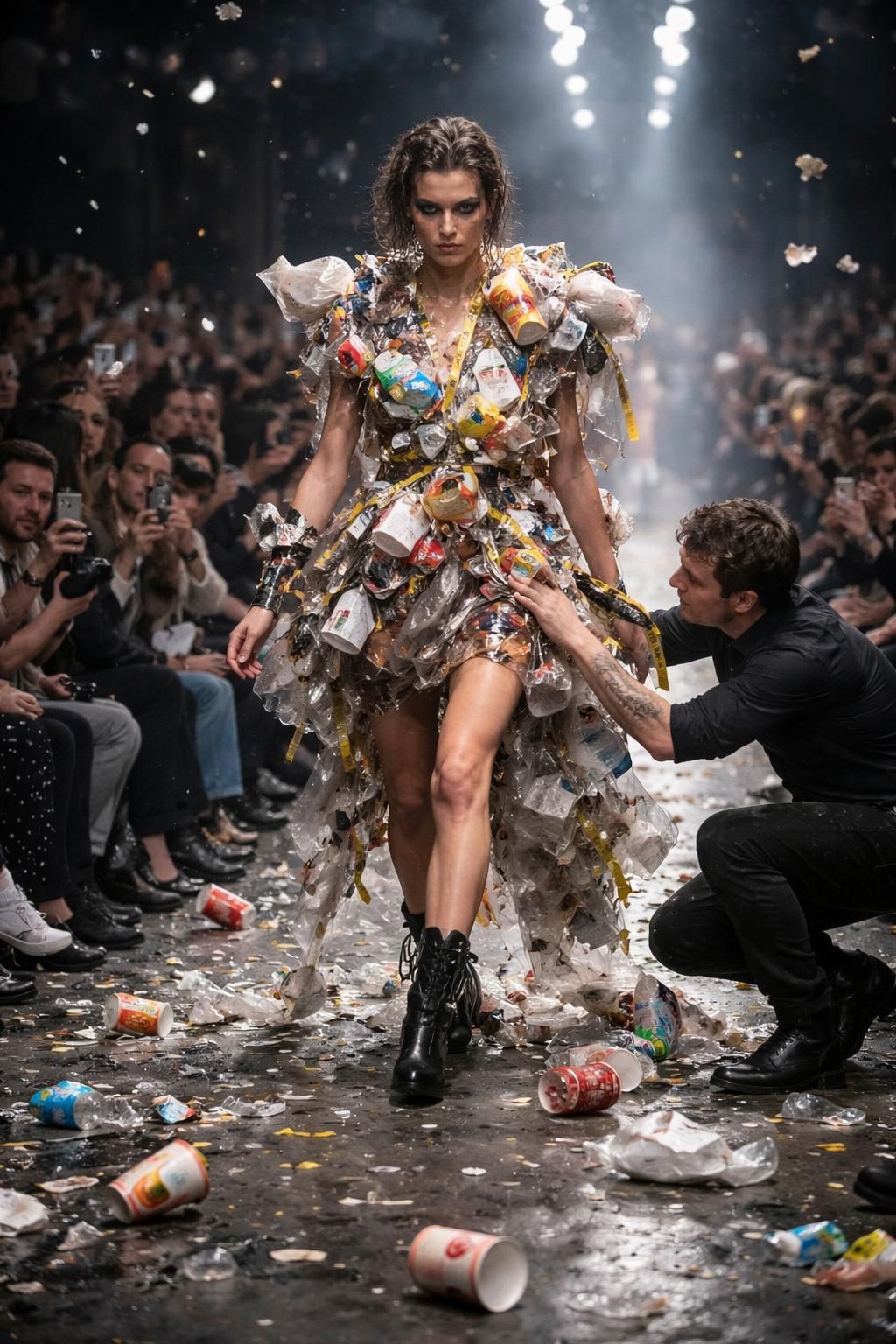
Parallel to the aesthetic rebellion runs a more hands-on movement: actual trash walking the runway. Across the globe in 2026, “Trashion” shows and “Trash the Runway” competitions are turning landfill detritus into high drama.Nonprofits like Trash the Runway challenge middle- and high-school students to create couture using at least 50–75% recycled materials — cardboard, plastic bags, old magazines, bottle caps, paint swatches. The results are jaw-dropping: ball gowns constructed entirely from folded newspaper fans, sculptural black dresses made of layered trash bags, shimmering silver ensembles pieced from color-sample cards. These aren’t costume projects; they’re runway-worthy statements that prove creativity thrives where waste ends.Brands like doba.upcycle in Johannesburg are taking the ethos professional. Their mantra — “ Trash is the New Trend We see beauty where others see waste” — translates discarded plastic caps, fabric scraps, and forgotten materials into chains, garments, and accessories. Plastic becomes thread. Waste becomes culture.These upcycled pieces don’t just look good — they make a point. In an industry long criticized for overproduction, turning literal garbage into glamour is both environmental activism and fashion flex.
Why Now? The Perfect Storm of Rebellion and Reality
The timing isn’t coincidental. After the pandemic stripped away pretense, after quiet luxury tried (and failed) to sell us invisibility as status, and as climate anxiety and political tension dominate headlines, perfection feels tone-deaf. Stains, rips, and recycled trash feel truthful. They mirror the mess we actually live in.Social media plays a role too. Algorithms rewarded flawless content for years; now the backlash favors raw, chaotic, human energy. “Collapsed economy core,” one TikTok commenter called the Prada stains — half joke, half cultural diagnosis.Sustainability demands it. Upcycling isn’t niche anymore; it’s mainstream necessity. And for marginalized voices like Trashy Clothing’s designers, “trashy” becomes a weapon — reclaiming a slur and turning it into resistance.
The Future Is Messy (and That’s the Point)
Trash is the new trend because it refuses to lie. It refuses the fantasy of endless newness, flawless execution, or apolitical escapism. Whether you’re wearing a Prada shirt with intentional coffee stains, a Trashy Clothing sword belt that doubles as protest art, or a student-made gown stitched from last week’s newspaper, the message is the same: beauty can come from what society throws away.So next season, when you see a model walking through confetti of scattered litter or a dress built from bottle caps, don’t call it sloppy. Call it forward-thinking. In 2026 and beyond, the most luxurious thing you can wear is the courage to be imperfect.
Citations
- “One Man’s Trash Is Another Man’s Treasure—Digging Into the Dirty Fashion Phenomenon,” Vogue, January 2026. https://www.vogue.com/article/dirty-destroyed-runway-trend-fashion
- “Trashy Clothing Stages Its First-Ever Runway Show at Paris Fashion Week,” MILLE WORLD, March 9, 2026. https://www.milleworld.com/trashy-clothing-stages-its-first-ever-runway-show-at-paris-fashion-week/
- “Trashy Clothing Fall/Winter 2026,” Fucking Young!, March 7, 2026. https://fuckingyoung.es/trashy-clothing-fall-winter-2026/
- doba.upcycle Instagram posts and brand ethos, 2025–2026 (multiple posts referencing “Trash is the New Trend”).
- Trash the Runway nonprofit events and Trashion Shows 2026 coverage (Boulder, Fort Worth, and various student competitions documented across Instagram and local reports).
The revolution isn’t coming in pristine packaging. It’s coming in stains, scraps, and satire — and it’s already on the runway.
Leave a Reply