

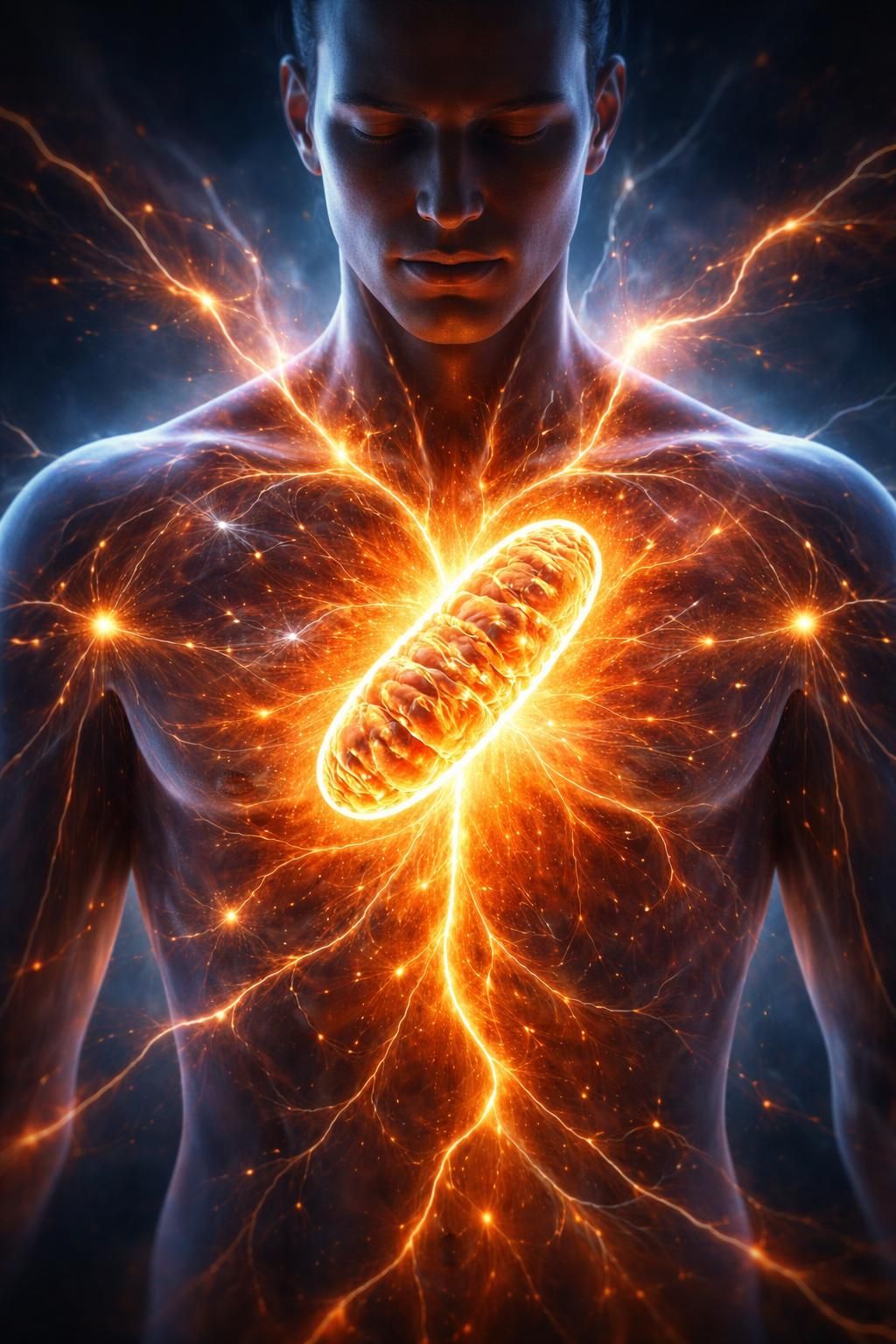



Mitochondrial Glow-Up: How 2023–2025 Research Is Shedding New Light on Biophotons as Cellular Messengers
Biophotons—ultra-weak photon emissions (UPE) from living cells—are emerging as a fascinating frontier in biophysics. These faint light signals (typically 1–1,000 photons per cm² per second across UV to near-infrared wavelengths) are produced primarily by mitochondria during oxidative metabolism, particularly through reactive oxygen species (ROS) generated in the electron transport chain. While long viewed as metabolic byproducts, recent studies (2023–2025) are probing whether they serve as subtle signals for non-chemical communication, stress responses, and even coordination within cells or between isolated mitochondria. This report summarizes the most up-to-date peer-reviewed findings as of early 2026, highlighting experimental evidence, theoretical models, health implications, and remaining caveats.
Core Mechanism: Mitochondria as the Primary Biophoton Source
Mitochondria generate most cellular biophotons via ROS reactions (e.g., singlet oxygen, excited carbonyls) that release photons upon relaxation. This process ties directly to ATP production and oxidative stress. Emissions change with cellular health: low and stable in healthy cells (~10–12 photons/s in some cultures), but variable under stress, toxins, or disease. Microtubules may act as waveguides or amplifiers, and DNA (nuclear and mitochondrial) is sometimes proposed as an information-carrying source in theoretical models.
Landmark 2023 Study: Evidence of Light-Based Mitochondrial Communication
The most direct experimental support for biophoton-mediated signaling came in a 2023 paper by Rhys R. Mould and colleagues. Isolated mitochondria from human cancer (MCF7) and non-cancer (MCF10A) cell lines were placed in separate quartz cuvettes (preventing chemical or physical contact). When one set was stressed with antimycin (an electron transport chain inhibitor), the oxygen consumption rate (OCR) of the unstressed set changed significantly—decreasing in most conditions—only when light could pass between them. An opaque barrier or complete darkness largely abolished the effect, strongly implicating photonic (biophoton) signaling. Cancer-derived mitochondria showed stronger responses, consistent with their higher baseline ROS. The authors concluded this supports non-chemical, light-based communication, though they noted it could involve ultra-weak photons or related electromagnetic phenomena rather than classical biophotons alone. This built on decades of UPE research (dating to Gurwitsch’s 1920s “mitogenetic radiation”) but provided one of the cleanest isolated-organelle demonstrations.
2024 Reviews: Consolidating Mechanisms and Roles
Mould’s 2024 brief review on ultra-weak photon emission summarized the field’s history, mitochondrial ROS pathways, and potential functions. It emphasized UPE as a byproduct of oxidative metabolism but highlighted emerging evidence for roles in cell-to-cell (or organelle-to-organelle) signaling, radiation-induced bystander effects, and diagnostics. Other 2024 work (e.g., Tong et al.) linked biophotons to radiation-induced bystander effects, with mitochondria and exosomes as key mediators—photons potentially traveling via gap junctions or vesicles to coordinate stress responses across cells.
2025 Advances: Imaging, Light Therapy, and Theoretical Models
- Imaging living glow (2024–2025): High-sensitivity CMOS cameras captured faint UPE from living mice (and plants under stress), which ceased after death. Mitochondria were implicated as the dominant source. This “ghostly glow” sparked renewed interest in biophotons for non-invasive monitoring.
- Red/near-infrared light modulates biophotons (Hoh Kam et al., Nov 2025): In Neuro-2a neurons and astrocytes, healthy cells emitted low-level biophotons (~12 photons/s). Stressors altered emissions (e.g., oxidizing agents increased them), and red/near-infrared light (660/850 nm) further modified patterns—especially under stress—without always matching ATP/ROS changes. The authors suggested biophotons may reflect cell health and that photobiomodulation (red light therapy) interacts with the mitochondrial biophoton system to aid repair.
- Brain and whole-body models (Nevoit et al., June 2025): A perspective article proposed a detailed “biophotonic signaling” framework: mitochondrial and nuclear DNA emit photons carrying genetic information, forming coherent electromagnetic fields. These fields, amplified by mitochondrial density in neurons (via migrating spherical mitochondria and microtubule networks), enable rapid intracellular and inter-neuronal coordination—potentially contributing to brain rhythms, consciousness models, and psychosomatic regulation. It cited correlations between UPE and EEG/activity but remained largely theoretical, calling for more experiments.
- Other 2025 work: UPE detected as optical markers of human brain activity (Casey et al.); links to mental health via mitochondrial dysfunction; and embryo studies showing mitochondrial/peroxisomal contributions.
Implications for Health, Diagnostics, and Therapy
These findings suggest biophotons could serve as non-invasive biomarkers for mitochondrial function, oxidative stress, cancer, neurodegeneration, or even brain states. Red/near-infrared therapies (already used clinically) may work partly by tuning biophoton emissions. In disease contexts, disrupted signaling might contribute to “bystander” effects or impaired cellular coordination. However, mainstream biology still prioritizes chemical (ROS, calcium, ATP) and electrical pathways; photonic roles remain supplementary and context-dependent.
Limitations and Outlook
Most evidence is correlative or from isolated systems; direct, real-time photon detection in intact tissues is technically challenging due to ultra-low intensity. Distinguishing signaling from byproduct effects requires more replication. Theoretical models (e.g., coherent fields, solitons) are intriguing but speculative. As of March 2026, no paradigm-shifting clinical trials have emerged, but improved detectors and quantum-biology tools are accelerating progress. Future research may integrate biophoton analysis into mitochondrial medicine, phototherapy optimization, and even agricultural or neurological diagnostics.In summary, mitochondria are indeed “glowing” powerhouses, and 2023–2025 studies have moved biophoton research from fringe curiosity toward testable hypotheses about light-assisted cellular dialogue. While not yet proving we are “light beings,” the data illuminate a radiant layer of biology worth watching.
Citations
- Mould RR, et al. (2023). Non-chemical signalling between mitochondria. Frontiers in Physiology. DOI: 10.3389/fphys.2023.1268075. https://www.frontiersin.org/journals/physiology/articles/10.3389/fphys.2023.1268075/full
- Mould RR, et al. (2024). Ultra weak photon emission—a brief review. PMC (Oncotarget context). https://pmc.ncbi.nlm.nih.gov/articles/PMC10899412/
- Hoh Kam J, et al. (2025). Red and near-infrared light treatment can change the intensity of biophoton emissions in cell culture. Scientific Reports. DOI: 10.1038/s41598-025-22344-0. https://www.nature.com/articles/s41598-025-22344-0
- Nevoit G, et al. (2025). The concept of biophotonic signaling in the human body and brain. Frontiers in Systems Neuroscience. DOI: 10.3389/fnsys.2025.1597329. https://www.frontiersin.org/journals/systems-neuroscience/articles/10.3389/fnsys.2025.1597329/full
- Salari V, et al. (2024 preprint, published context 2025). Imaging Ultraweak Photon Emission from Living and Dead Mice. bioRxiv. https://www.biorxiv.org/content/10.1101/2024.11.08.622743v1
- Tong J, et al. (2024). Biophoton signaling in mediation of cell-to-cell communication and radiation-induced bystander effects. Radiation Medicine and Protection. DOI: 10.1016/j.radmp.2024.06.004.
.
Leave a Reply