



Bacterial Sunscreen Factories: Engineered E. coli Produces Fish Egg UV Protector at Industrial Promise Levels
A groundbreaking study from Jiangnan University in China demonstrates how common laboratory bacteria can be transformed into efficient “microbial cell factories” to produce gadusol, a natural cyclohexenone compound with powerful UV-protective and antioxidant properties. Originally discovered in fish eggs (notably from species like cod, zebrafish, salmon, and sturgeon), gadusol acts as a maternal sunscreen, shielding transparent marine embryos from harmful ultraviolet radiation. This recent advance, published online on May 13, 2026, in the journal Trends in Biotechnology, achieves a remarkable ~93-fold improvement in production titer, reaching 4.2 grams per liter in a bioreactor — a level that brings gadusol closer to practical, sustainable applications in sunscreens, cosmetics, and food industries.
What Is Gadusol?
Gadusol (3,5,6-trihydroxy-5-hydroxymethyl-2-methoxycyclohex-2-en-1-one) strongly absorbs UVB (and some UVC) wavelengths, with peak absorption around 296 nm (neutral pH) or 268 nm (acidic conditions). Beyond UV blocking, it exhibits antioxidant activity comparable to — or in some assays superior to — vitamin C (ascorbic acid), effectively scavenging free radicals and potentially mitigating oxidative stress from UV exposure. In nature, fish mothers deposit gadusol into eggs via a two-enzyme biosynthetic pathway starting from the pentose phosphate pathway intermediate sedoheptulose-7-phosphate (S7P). The enzymes are:
- 2-epi-5-epi-valiolone synthase (EEVS)
- Methyltransferase-oxidoreductase (MT-Ox), which requires cofactors SAM and NAD⁺.
A 2023 study in Current Biology confirmed gadusol’s critical role as a maternally provided sunscreen in zebrafish embryos, protecting against UV-induced DNA damage (e.g., cyclobutane pyrimidine dimers), cellular stress, and mortality — more effectively than melanin in early developmental stages.
The New Breakthrough: Multidimensional Engineering of E. coli
Led by researchers including Ping Zhang and senior author Ruirui Xu, the team reconstructed the zebrafish-derived gadusol pathway in Escherichia coli BL21(DE3). Starting from a modest 45.2 mg/L titer, they applied a systematic “multidimensional” engineering strategy:
- Pathway reconstruction and balancing: Optimized promoters (e.g., Psh) and ribosome binding sites (RBS) for balanced EEVS and MT-Ox expression.
- High-throughput screening: Developed a clever colorimetric assay exploiting gadusol’s antioxidant properties — a purple dye shifts to yellow as gadusol neutralizes free radicals, enabling rapid, cost-effective quantification of thousands of strains.
- Regulatory optimization: Used a small RNA (sRNA) library to identify and fine-tune key genetic targets.
- Enzyme and cofactor engineering: Directed evolution of transketolase A (TktA) to boost precursor supply, plus enhancements to NAD⁺ and SAM biosynthesis/regeneration.
- Fermentation scale-up: Fed-batch cultivation in a 5-L bioreactor yielded 4.2 g/L gadusol with a productivity of 0.26 g/L/h.
They also established efficient downstream extraction and purification protocols, achieving high-purity gadusol suitable for further testing.
Comparison to Prior Work
Previous microbial efforts were far less efficient:
- Engineered Streptomyces coelicolor reached ~1.1 g/L of gadusol-related compounds after 13 days.
- Engineered Saccharomyces cerevisiae (yeast) achieved only ~20 mg/L after 48 hours.
Patents and earlier studies (e.g., from Oregon State University researchers like Taifo Mahmud and Andrew Osborn) explored gadusol biosynthesis in bacteria and yeast, confirming the pathway and producing derivatives, but titers remained low for industrial use. Natural extraction from fish roe yields are very low (e.g., max ~245 mg/L reported in some species) and environmentally costly.
Potential Applications and Advantages
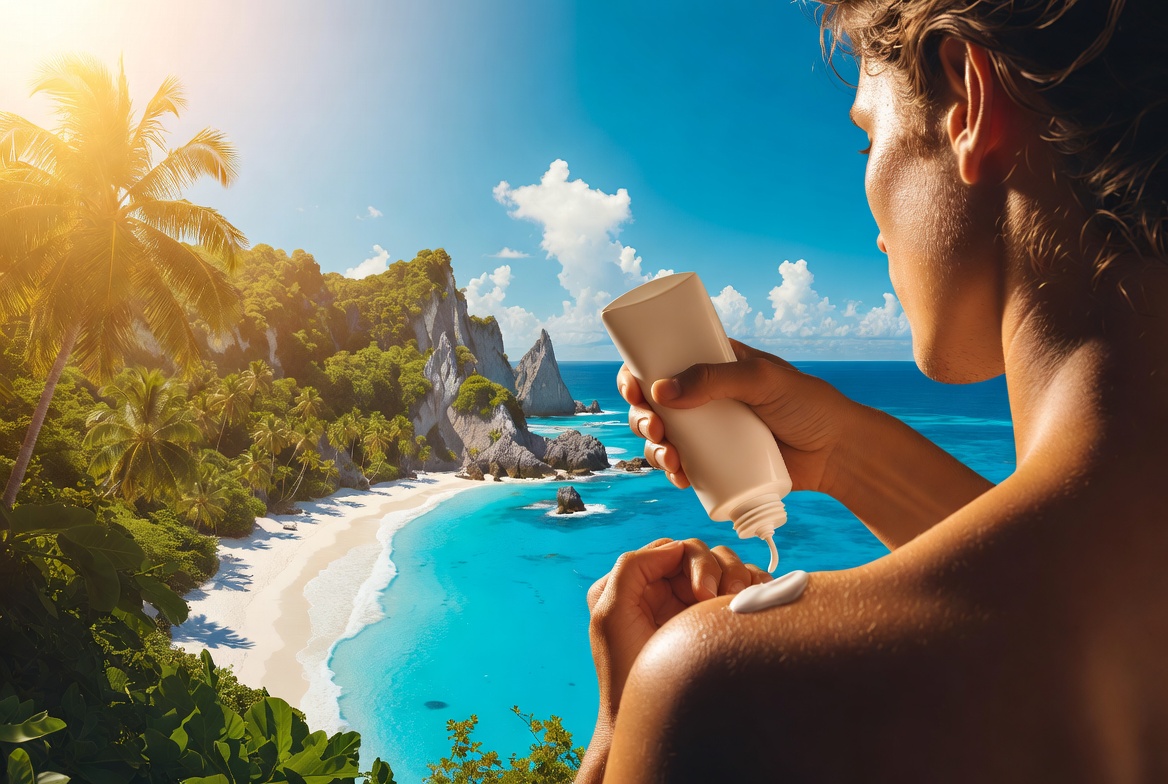
Gadusol offers a “green chemistry” alternative to synthetic UV filters, some of which have raised concerns about skin irritation, coral bleaching, or petrochemical origins. Its dual UV-blocking + antioxidant profile makes it attractive for:
- Sunscreens and skincare
- Food preservation (antioxidant)
- Pharmaceuticals or nutraceuticals
It could be particularly valuable for eco-friendly cosmetics targeting marine-safe claims.
Limitations and Next Steps
The study authors note this reaches a Technology Readiness Level (TRL) of ~5 (lab-validated in relevant environments). Key challenges remain:
- Strain stability for multi-batch production
- Further process optimization and pilot-scale validation
- Regulatory review for cosmetic/food use
- Material science work for formulation into consumer products (stability, efficacy vs. commercial sunscreens, long-term safety)
Industrial-scale, cost-competitive manufacturing is not yet proven, but the high titers provide a strong foundation.
Broader Context
This work fits into a larger trend of synthetic biology enabling sustainable production of marine-derived compounds. It highlights how understanding vertebrate biosynthesis (discovered around 2015) can be translated into microbial platforms.
Citations/References (key sources):
- Zhang et al. (2026). “Multidimensionally engineered Escherichia coli for efficient gadusol biosynthesis…” Trends in Biotechnology. DOI: 10.1016/j.tibtech.2026.03.013.
- EurekAlert / Cell Press press release (May 2026).
- Rice et al. (2023). “Gadusol is a maternally provided sunscreen…” Current Biology.
- Osborn et al. (2015). “De novo synthesis of a sunscreen compound in vertebrates.” eLife.
- Additional coverage: New Scientist, GEN (Genetic Engineering & Biotechnology News).
This research represents a significant step toward bio-manufactured, nature-inspired sun protection — turning bacteria into tiny, sustainable sunscreen producers. Further developments will determine how quickly it reaches consumers.
Leave a Reply