

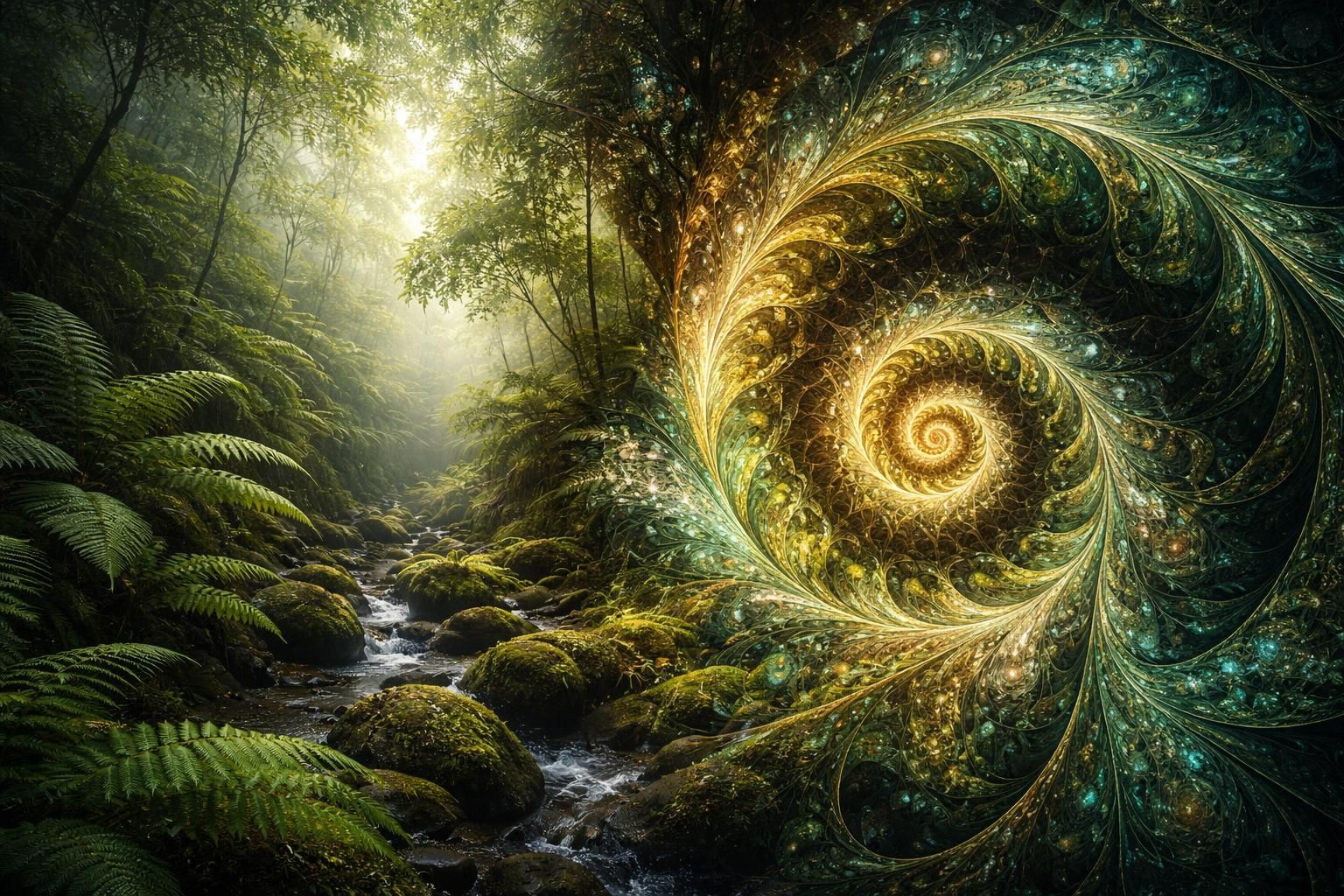



Ferns, fractals and calm: how patterned nature soothes the nervous system
- Viewing natural fractal patterns (e.g., fern fronds, tree branches, waves) is associated with measurable reductions in physiological stress and increases in markers of relaxed brain activity.
- Effects are strongest for mid‑range fractal complexity (fractal dimension D ≈ 1.3–1.5).
- Mechanisms are likely a mix of low‑level visual/neural processing and higher‑level psychological/evolutionary factors; claims of a single, purely “mathematical” cause are overstated.
- Evidence is robust in controlled lab studies but varies across individuals and contexts; cortisol evidence is scarcer than EEG/skin‑conductance findings.
Background
- Fractals are patterns showing statistical self‑similarity over a range of scales. Many natural forms (ferns, coastlines, clouds, tree canopies) exhibit statistical fractal structure rather than perfect mathematical fractality; that is, they repeat similar patterns across a limited range of sizes.
- Human visual systems evolved to process natural scenes efficiently. Researchers propose that certain fractal complexities align well with the brain’s processing preferences, producing perceptual fluency and reduced neural “effort,” which correlates with lower physiological arousal.
Key empirical findings
- Physiological measures: Multiple studies report reductions in skin‑conductance responses (a measure of sympathetic arousal) and decreases in heart rate when participants view natural fractal images versus non‑fractal or high/low complexity patterns.
- EEG/brain activity: Studies show increases in alpha-band activity (commonly linked with relaxed wakefulness) when participants view fractal patterns, particularly those in the mid‑D range.
- Behavioral/aesthetic responses: People commonly rate mid‑range fractal patterns as more pleasant or soothing; eye‑movement studies indicate more relaxed visual scanning for such images.
- Complexity dependence: Effects are not monotonic — very simple or very complex fractal images are less calming than mid‑range complexity images (the commonly reported preferred range D ≈ 1.3–1.5).
- Natural vs. exact fractals: “Statistical” natural fractals (irregular, organic) produce stronger relaxation effects than artificially perfect mathematical fractals in many studies.
Mechanisms (plausible, not mutually exclusive)
- Perceptual fluency: Mid‑range fractals match typical scene statistics, making them easier to process and reducing neural load.
- Evolutionary/biophilic account: Repeated exposure to fractal‑rich natural environments across evolutionary history may have biased the nervous system toward calm responses when encountering such patterns (evidence is indirect).
- Attentional capture and soft fascination: Natural fractal patterns promote a gentle, involuntary attention that reduces directed‑attention fatigue and stress.
- Multisensory/context effects: Fractals in natural settings co‑occur with other calming cues (sounds, smells, air quality), so whole‑environment effects can amplify pattern‑only effects.
Limitations and open questions
- Cortisol: Few studies directly measure cortisol; most rely on faster physiological markers (EEG, skin conductance, heart rate). Cortisol studies are needed to confirm endocrine stress changes.
- Individual differences: Prior experience, cultural background, visual acuity, and current mood moderate effects.
- Ecological validity: Laboratory images and real natural scenes can differ; field studies support lab results but effect sizes and durations vary.
- Causality and specificity: While correlations with relaxation are consistent, pinpointing a single causal mechanism (mathematical fractality alone) is premature.
Practical implications
- Short interventions: Looking at natural fractal images (or real leaves, waves, clouds) for a few minutes can provide a low‑cost, immediate calming effect for many people.
- Design applications: Incorporating mid‑range fractal patterns into interiors, architecture, or digital content may enhance perceived comfort and reduce stress, but should be combined with other supportive environmental features.
- Further research: Studies combining long‑term cortisol measures, diverse populations, and naturalistic settings would strengthen causal claims.
- The general claim — that viewing natural fractal patterns can reduce stress — is supported by multiple experimental studies. However, the effect is nuanced: natural fractals are statistically self‑similar (not infinitely repeating), the calming response is biological and psychological (not purely mathematical), and cortisol evidence remains limited.
Key references
- Taylor, R. P. and collaborators — multiple empirical papers on fractal images, EEG, and physiological responses (2003–2016).
- Hagerhall, C. M., Küller, R., and colleagues — studies comparing statistical vs. exact fractals and EEG/physiological markers of relaxation.
- Additional perceptual and environmental psychology literature on fractal dimension, aesthetics, and stress (experimental papers in journals such as Perception, Frontiers, Leonardo, and environmental psychology outlets).
Leave a Reply